The Repeated Variable Concept
Comparison Concept and the
Part-Whole Concept . This concept is applicable when the problem deals with one or more variables that is repeated, i.e., it is related to more than 1 variable in the question. For example, A is 1/2 of B and B is 2/3 of C. Thus B is the repeated variable.
To illustrate this concept, consider the following question.
Jane has 3 times as much money as Cindy. Lea has twice as much money as Jane. If Lea has $30 more than Cindy, how much money does Jane have?
Answer: Take note that Jane is the repeated variable,i.e., she is related to Cindy and then to Lea.
Step 1: Draw 1 box to represent Cindy's money and 3 boxes to represent Jane's money.
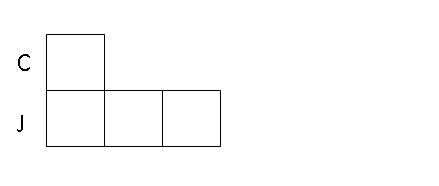
Step 2: Since Lea has twice as much as Jane, we draw twice as many number of units as Jane to represent Lea's money,i.e., 2 x 3 units = 6 units.
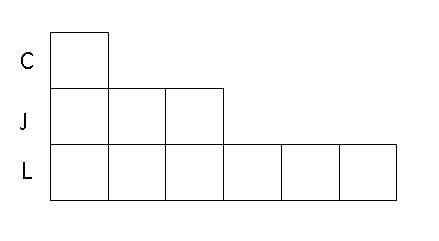
Step 3: From the question, we know that Lea has $30 more than Cindy. Since Lea has 5 units more than Cindy, then 5 units must be equal to $30.
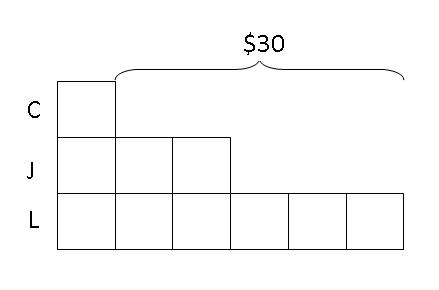
5 units -----------> $30
1 unit ------------> $30 / 5 units = $6
3 units -----------> 3 units X $6 = $18
Therefore, Jane has $18.
Go To Top - Repeated Variable Concept
If you want us to send you our future Modelmatics eZine that would inform you on the latest article in Teach Kids Math By Model Method, do an easy sign-up below. Subscription is FREE!


