Questions and Answers
Question posted by Swee Keng from Singapore:
A tank with a base of dimensions 30 cm by 24 cm was a quarter full of water. When another 4.536 litre of water were poured into the tank, it became 3 fifth full.
a) find the capacity of the tank in litres
b) what was the height of the water in the tank when it was three-fifth full?
Answer:
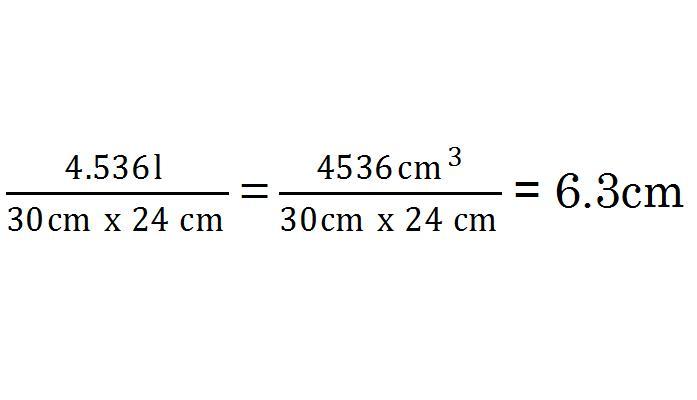
Step 1: Since the base dimensions of the tank will always remain the same, so the increase in water level is,
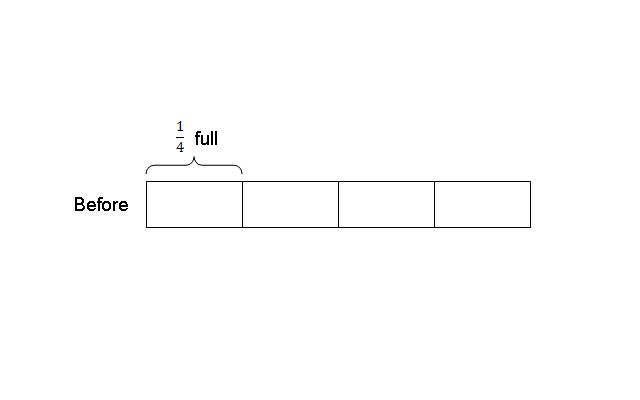
Step 2: Draw a long bar to represent the full height of the tank. Divide the long bar into 4 equal parts and mark the first bar to show that a quarter of the tank was filled (1/4 of the full height). This is the "before" model, i.e., before the additional 4.536 litre of water was added.
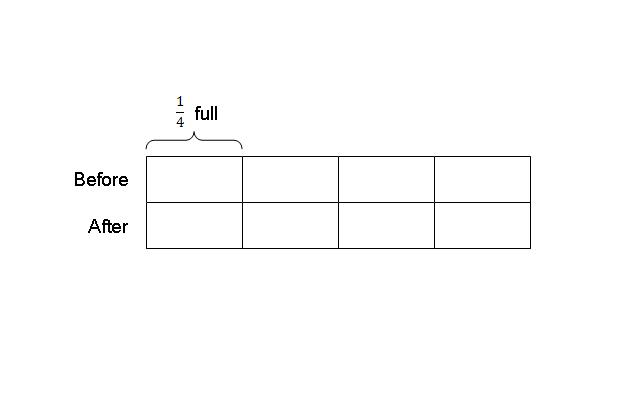
Step 3: Draw 4 identical boxes below the "before" model to represent the height of the tank after the 4.536 litre of water was added. This is the "after" model.
Step 4: Since we need to show 3/5 of the tank being filled with water in the "after" model and there are only 4 boxes (we need it to be 4 boxes so that we can compare it with the "before"model), we need to find the common multiple between the numbers "4" (4 boxes) and "5" (5 fifths). The common multiple of "4" and "5" is 20. So we sub-divide each of the 4 boxes into 5 smaller boxes creating 20 small boxes in total. Then, we can work out that 3/5 of 20 boxes is 12 small boxes, so we mark 12 small boxes as 3/5 of the tank.
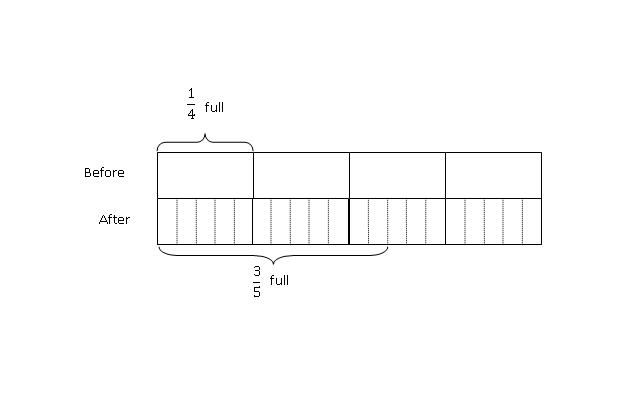
Step 5: Similarly, we sub-divide the "before" model into 20 small boxes to draw comparison between the 2 models. Then, we can easily see that the difference between the "before" and "after" models is actually equal to 6.3cm (the difference in height found in Step 1).
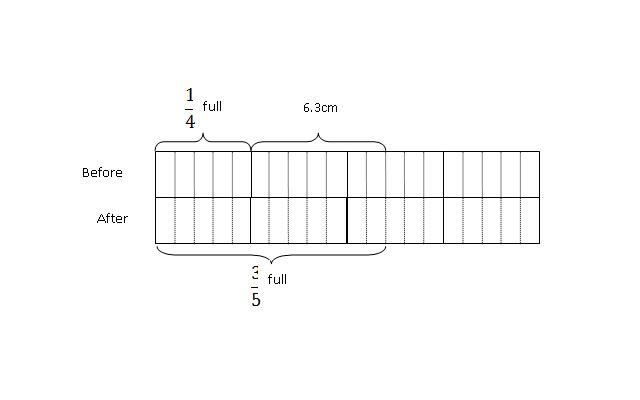
Step 6: Now, we can work out the full height of the tank,
7 units ----------> 6.3cm
1 unit -----------> 6.3cm / 7 = 0.9cm
20 units ---------> 20 x 0.9cm = 18cm (full height of tank)
(a) Capacity of tank = 30cm X 24cm X 18cm = 12960 cubic cm or 12.96 litres
(b) to find height of tank when it was 3/5 full,
1 unit -----------> 0.9cm
12 units ---------> 12 X 0.9cm = 10.8cm


